3 junija, 2026
Optimizing production lines is one of the fastest ways to higher productivity, lower costs, and improve competitiveness. Yet many manufacturing companies still waste a large portion of their capacity due to bottlenecks, unnecessary movements, waiting, inadequate planning, and a lack of data for decision-making.
In practice, we often find that a production line that is supposed to be operating at 90% efficiency actually achieves significantly less. The reason is usually not a lack of equipment, but rather inefficient processes, poor coordination between departments, and insufficient visibility of losses.
What does production line optimization mean?
Production line optimization represents the systematic improvement of production processes with the aim of:
- increase productivity,
- loss reduction,
- quality improvement,
- shortening throughput times,
- increasing production flexibility,
- better use of existing resources.
The goal is not just to produce more products. The goal is to create a stable, predictable and efficient production system that enables sustainable growth of the company.
Where do companies most often lose efficiency?
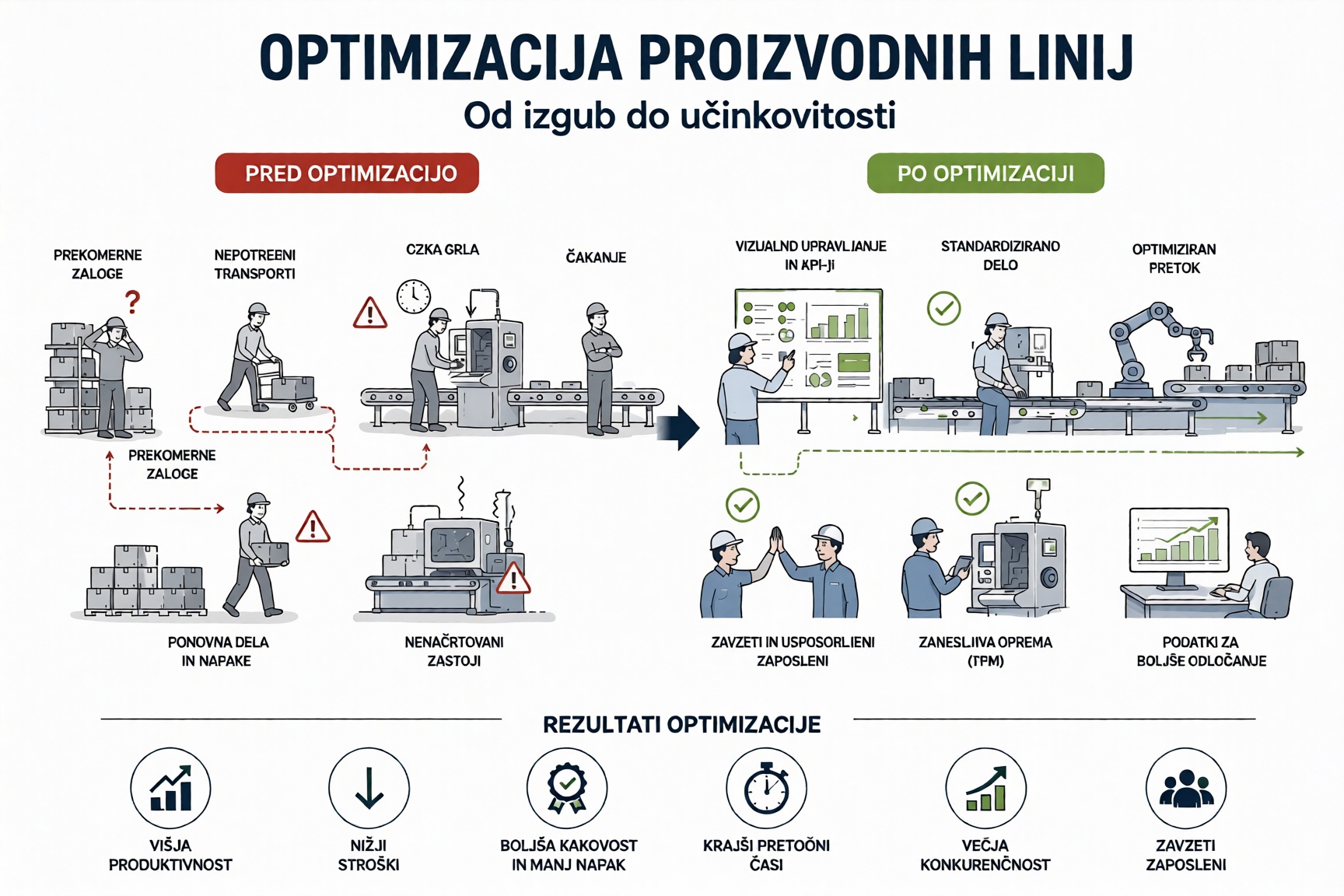
The following losses most often occur in production process analyses:
- waiting for the material,
- waiting for a decision or approval,
- unnecessary transports,
- excessive inventories,
- rework and complaints,
- unplanned delays,
- untapped potential of employees,
- lack of labor standards.
In Lean Manufacturing terminology , we talk about various forms of waste (Muda) that directly affect productivity and costs.
How to approach production line optimization?
Successful optimization is not a one-time project, but a structured process.
1. Analysis of the current situation
The first step is to understand the actual situation.
The methods used are:
- Gemba Walk,
- Value Stream Mapping (VSM),
- material flow analysis,
- cycle analysis,
- OEE measurement,
- recording work processes.
Without data, companies often optimize the wrong problems.
2. Identification of bottlenecks
Every production line has a limit.
According to the theory of constraints (TOC), the total capacity of a system can never exceed the capacity of its weakest link.
Typical bottlenecks are:
- machines with long settings,
- manual operations,
- quality control points,
- internal logistics,
- lack of trained operators.
3. Elimination of waste using Lean methods
The most commonly used methods include:
- 5S ,
- Kaizen ,
- SMED ,
- TPM (Total Productive Maintenance) ,
- Standard Work ,
- Visual Management ,
- Daily Management System (DMS) .
The most successful companies do not use these methods individually, but as an integrated management system.
Practical example: reducing congestion on the assembly line
The manufacturing company experienced frequent assembly interruptions.
Initial problem
- frequent traffic jams,
- unclear causes,
- lack of responsibility for fixing problems.
Method used
- TPM analysis,
- structured problem solving,
- daily operational meetings.
Implemented solution
A system for recording losses was established, responsible activity holders were identified, and daily monitoring of open measures was introduced.
Result
- 28% fewer unplanned delays,
- 12% higher OEE,
- faster resolution of recurring problems.
Key teaching
Companies often don’t need new equipment. They need a better process management system.
Digitalization of production optimization
More and more companies are finding that Excel spreadsheets and manual process monitoring do not enable fast enough decision-making.
Therefore, they become important:
- digital KPI systems,
- digital audits,
- task management systems,
- digital problem solving,
- competence management systems,
- AI-powered analytics.
Digitalization allows problems to be discovered faster and for managers to make decisions based on real data.
Lean 5.0: the next step in production line optimization
Companies today no longer just optimize machines and processes.
The Lean 5.0 concept connects:
- people,
- processes,
- data,
- artificial intelligence,
- sustainable development.
The goal is not just greater productivity, but better decision-making, faster organizational learning, and greater company resilience.
AI can help with:
- loss forecasting,
- pattern recognition in production,
- discovering hidden causes of problems,
- support for decision-making of leaders.
However, AI does not solve problems on its own. It creates the most value when it is connected to a well-established operational management system.
How does Performance Storyboard® help with this?
In many projects, it turns out that the biggest problem is not a lack of ideas for improvements, but a lack of implementation.
Performance Storyboard® as an AI-supported Lean 5.0 Performance Management System connects:
- strategy,
- goals,
- Key Results,
- KPIs,
- audits,
- problem solving,
- projects,
- competencies,
- tasks,
- daily meetings.
In this way, the company creates a unified performance management system from management to the production line.
Frequently Asked Questions (FAQ)
How quickly do the results of production line optimization appear?
The first results are usually visible within a few weeks, with major improvements occurring within 3–6 months.
Which method is the most effective?
There is no one universal method. The best results are achieved by a combination of Lean, TPM, work standardization and digital process monitoring.
Does optimization also make sense for smaller companies?
Yes. Smaller companies often achieve very fast results because they have shorter communication channels and faster decision-making.
Is new equipment needed for optimization?
In most cases, no. The greatest potential usually lies in organizing work, eliminating waste, and better managing processes.
Conclusion
Production line optimization is not a cost-cutting project. It is a systematic approach to creating more efficient, more stable, and more competitive production.
Companies that successfully combine Lean methods , TPM , digitalization , AI , and structured operational management create the foundation for long-term growth and operational excellence.
- Hrvatski
- Slovenščina
- Српски језик