29 junija, 2026
The terms Industry 5.0, artificial intelligence, digital transformation and Lean 5.0 have increasingly been used in discussions about the future of manufacturing companies in recent years. With so many new technologies, it often seems that traditional Lean management is gradually losing its relevance and that organizations need a completely new way of leading.
Experience from manufacturing companies shows a different picture.
The fundamental challenges remain the same. Organizations are still striving to reduce waste, improve quality, increase productivity, shorten response times, and develop a culture of continuous improvement. The main difference is that today they have significantly more data and advanced digital tools at their disposal that can significantly improve the speed of decision-making.
It is from this development that the term Lean 5.0 comes from.
Although a single professional definition does not yet exist, most authors use the term to describe the development of lean management, which combines established Lean principles with digital technologies, artificial intelligence, sustainable development, and humans as the central driver of improvements.
In our opinion, Lean 5.0 does not represent a new methodology.
It represents a natural evolution of Lean management in an environment where digital technology supports faster decision-making, better process transparency, and more effective collaboration between people.
What has actually changed in manufacturing companies?
Fifteen years ago, one of the biggest constraints was the lack of timely information. Today, the situation is almost the opposite.
Most manufacturing companies are using ERP systems, tracking key performance indicators, implementing MES and OEE systems, using IoT sensors, and collecting more and more data about their production processes. Managers have more information at their disposal than ever before.
Their biggest challenge is therefore no longer access to data.
The biggest challenge is making the right decision at the right time.
What do we observe in manufacturing companies?
In DEMETRA Lean Way projects ,
we most often encounter the following challenges:
- data is scattered across different information systems,
- individual departments use different performance indicators,
- Deviations only become visible when they affect production,
- activities are not always clearly linked to responsible persons,
- Solving problems often takes longer than necessary.
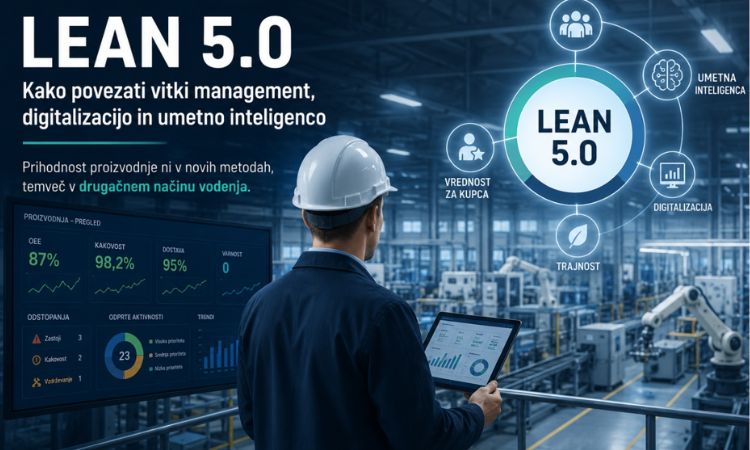
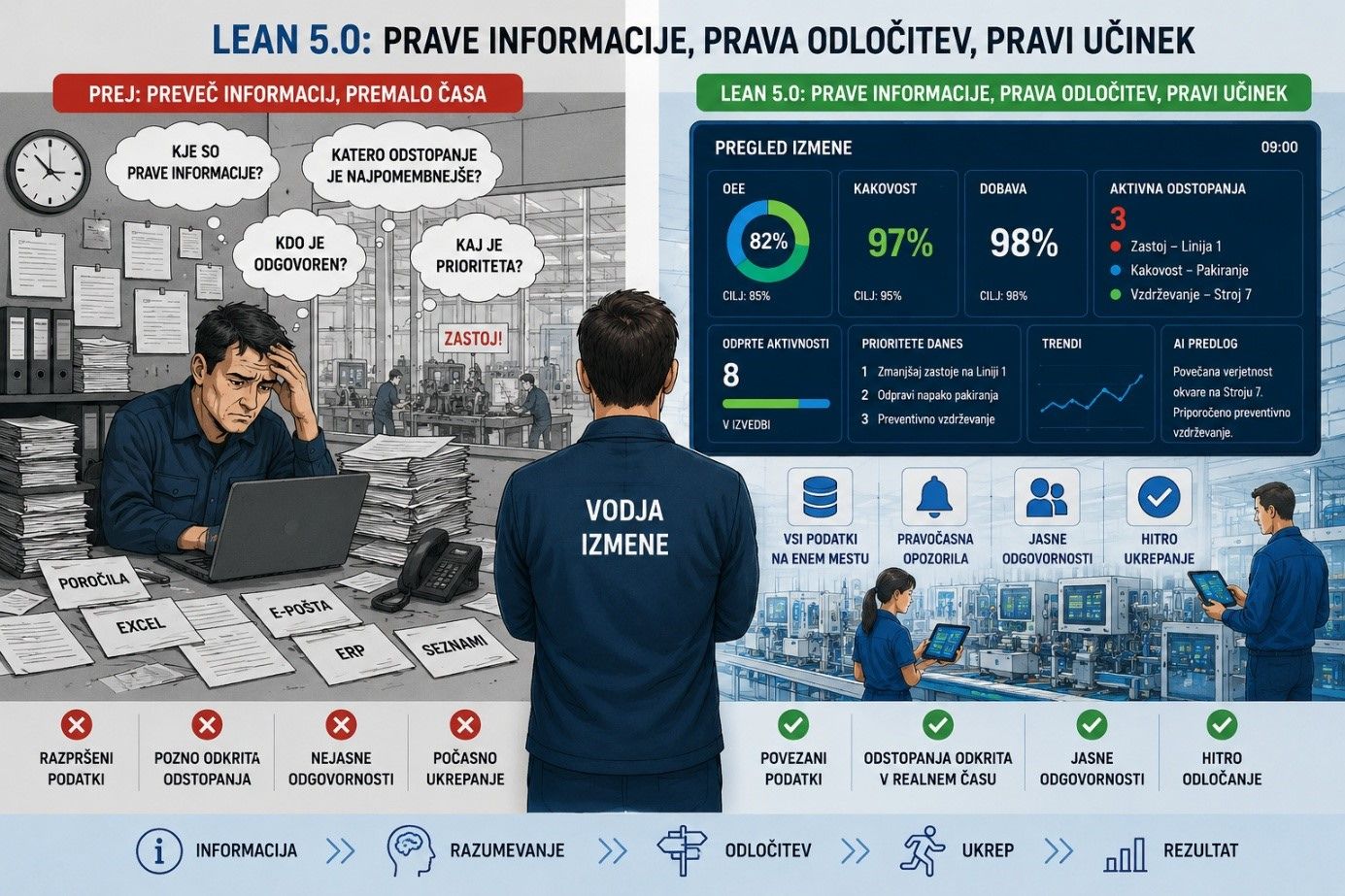
The shift manager has just a few minutes before the morning operations meeting to set priorities for the next eight hours. He needs a clear overview of key deviations, open tasks and risks that can affect the production process.
The greatest competitive advantage of the future will not be data. The advantage will be given to organizations that know how to turn it into timely decisions.
Lean principles remain the foundation of operational excellence
Digital transformation has not changed the basic principles of Lean management.
Organizations still achieve the best results when they systematically eliminate waste, standardize processes, involve employees in improvements, and make decisions based on facts.
That is why the companies that are most successful in implementing artificial intelligence today almost always have a well-developed culture of operational excellence.
Their daily work is still based on methods such as:
- 5S,
- Kaizen,
- TPM,
- PDCA,
- A3 and 8D,
- Gemba,
- visual management,
- standardized work.
These methods have not lost their relevance. On the contrary, they create stable processes where digital tools and artificial intelligence can create the greatest added value.
How does Lean 5.0 change daily operational management?
The biggest change brought about by Lean 5.0 is not the introduction of new methods. It is the change in the way an organization uses information in its day-to-day production management.
Operational management has always been about making decisions. Which activities have the highest priority today? Which downtime poses the greatest risk? Where are the biggest losses occurring? How to allocate available people and resources?
Digital technologies do not answer these questions for people. But they do enable leaders to get answers faster, based on more reliable information, and with a much better overview of what is happening.
What does the start of a shift look like in a company that lives Lean 5.0?
The morning operational meeting is not intended for preparing reports. It is intended for decision-making.
The production manager and his team review the results of the previous day, the status of key KPIs, open tasks, quality deviations, maintenance activities, and potential risks for the current shift. The goal of the meeting is to determine priorities, responsible persons, and actions that will have the greatest impact on production performance.
When information is collected in one place, decisions become faster, communication between departments becomes more efficient, and the organization becomes significantly more responsive.
This is where Lean 5.0 creates the greatest added value.
What changes for individual roles?
Lean 5.0 is not about technology. It is about the people who run processes and make decisions every day.
The shift manager sets priorities more quickly, monitors the implementation of agreed activities, and identifies deviations in a timely manner.
The maintenance technician receives a warning about changes that may indicate an upcoming failure. He can plan the intervention during a regular production stoppage, thereby preventing unplanned downtime.
The quality manager connects customer complaints, root cause analysis, corrective actions, and verification of their effectiveness into a unified process.
The production manager has an overview of key KPIs, open issues, and improvement progress. Instead of collecting information, he can spend more time on decision-making and developing the organization.
An important advantage of this approach is the shorter time from the detection of a problem to the implementation of the action. In a production environment, this time often determines whether a deviation will be quickly resolved or will cause a production stoppage, a delay in delivery or a customer complaint.
Lean 5.0 connects the entire organization
Operational excellence has long ceased to be the responsibility of production alone.
Quality, maintenance, logistics, purchasing, development and human resources all have an equal impact on an organization’s performance. If each department uses its own data, its own priorities and its own ways of monitoring results, it becomes more difficult for the organization to make coordinated decisions.
Lean 5.0 encourages a different approach.
All departments use the same key information, pursue common goals, and collaborate to eliminate waste. Such integration improves process transparency, shortens response times, and enables significantly more efficient collaboration between business functions.
That’s why Lean 5.0 is much more than the digitalization of production. It represents a management approach that connects people, processes, and technology into a unified operational decision-making system.
Digitalization without a culture of improvement does not bring the expected results
In digitalization projects, we often see that companies focus the most on choosing software, but spend much less time thinking about how they will integrate the new solution into their daily work routines.
Therefore, a successful implementation of Lean 5.0 always starts with people.
Employees need to understand the processes, responsibilities and goals of the organization. Leaders need clearly defined performance indicators, standardized ways of working and a culture in which problems are solved systematically and improvements become part of everyday activities.
Artificial intelligence doesn’t make better decisions. It enables people to make them faster, with more information and greater certainty.
Such an environment allows technology to become a natural support for operational excellence and not just another digital tool in the organization.
How to start implementing Lean 5.0?
The question we often hear in meetings with manufacturing company executives is no longer whether to go digital. The question is where to start.
Based on experience from numerous projects, we recommend a gradual introduction of changes. Organizations that build on stable processes and a clearly defined operational management method tend to benefit from digital technologies and artificial intelligence much faster.
Recommended path to Lean 5.0
Companies that successfully combine lean management and digitalization typically follow a similar sequence:
- stabilize and standardize key processes,
- determine KPIs that support business goals,
- develop a culture of continuous improvement and employee involvement,
- digitalize operational management processes,
- use artificial intelligence to support analysis, prioritization, and decision-making.
Such an approach reduces risks, increases acceptance of changes among employees, and enables long-term successful digital transformation.
From Lean management to Lean 5.0
More than two decades of working with manufacturing companies have taught us that the biggest challenge for organizations is not a lack of data. The challenge is connecting processes, people, and information into a way of working that enables fast and coordinated decision-making.
From these experiences, the Performance Storyboard® gradually evolved.
Not as a goal of digitalization, but as a response to the needs of manufacturing companies that want to connect operational management, KPI monitoring, problem solving, assessments, risk management, employee development, and continuous improvement into a unified work system.
This approach allows managers to have a single view of key information, responsibilities, and the execution of agreed activities. This allows the organization to identify deviations much faster, coordinate work between departments more effectively, and build a culture of operational excellence more easily.
Performance Storyboard® was therefore not created for the sake of digitalization. It developed from the practical needs of manufacturing companies that want to live Lean management every day and upgrade it with the possibilities brought by modern digital technologies.
Executive Insight
In our opinion, Lean 5.0 does not mean a new management philosophy. It means the development of proven Lean principles at a time when organizations have significantly more data, more powerful digital tools, and artificial intelligence at their disposal.
The fundamental principles remain the same – creating customer value, eliminating waste, engaging employees and continuously improving processes. What is changing is the speed at which organizations identify deviations, make decisions and implement improvements.
The companies that will create the greatest competitive advantage in the coming years will not choose between Lean management and digitalization. The successful ones will be those that combine both approaches into a unified way of operational management, where technology supports people, decisions are based on facts, and improvements become part of the daily work of the entire organization.
At DEMETRA Lean Way, we help manufacturing companies connect Lean management, digitalization and artificial intelligence into more efficient operational management. Contact us and discover how Lean 5.0 can become a competitive advantage for your company.
- Hrvatski
- Slovenščina
- Српски језик